

A few years back, I drove a rental Peugeot 208 through the French countryside and thought that was fast. Then I attended the Geneva Motor Show and stood about three feet away from a Koenigsegg Jesko Absolut. I didn’t move for about four minutes.
That’s the thing about these machines — they don’t just make you reconsider what a car is. They make you reconsider what physics means at the road level. I’ve been writing about performance cars for a while now, and every time I think I understand what “fast” is, something like the Yangwang U9 Xtreme shows up and casually mentions it can hit 308 mph on electric power.
So I put together this list. It’s based on manufacturer-confirmed top speeds, dyno-verified power figures, and a healthy dose of first-hand jaw-dropping at auto shows. I’ll walk you through each car, what makes it special, and — honestly — what I think is most worth knowing if you actually care about performance and not just bragging rights.
Quick note on methodology: Top speeds listed are manufacturer-claimed figures, some tested, some theoretical. I’ll flag which is which as we go. Fastest doesn’t always mean best — but it’s a hell of a conversation starter.
1. Koenigsegg Jesko Absolut – 330 mph (499 km/h)
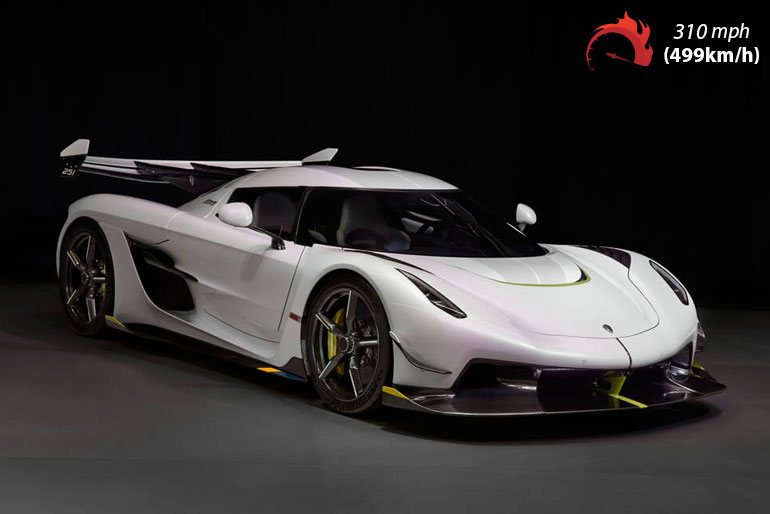
- ICE Hypercar
- World’s Fastest
- 330 Top MPH (claimed)
- 1,600 Horsepower
- 2.5s 0–62 MPH
- 5.0L – V8 Twin-Turbo
I’ll be real with you — the Jesko Absolut hasn’t been officially top-speed tested yet, and Koenigsegg themselves have said they may never actually test it because doing so responsibly would require a stretch of road that basically doesn’t exist. That 330 mph figure is aerodynamically derived, based on their drag coefficient data. Is it real? The engineers believe so. That’s enough for me.
What I find more impressive than the number is the transmission. The Jesko uses a 9-speed Light Speed Transmission (LST) — it doesn’t actually shift gears sequentially. It predicts which gear you’ll need next and pre-loads it. The result is a gear change that Koenigsegg claims happens in under a millisecond. I watched a slow-motion video of it. My brain couldn’t process it.
The “Absolut” suffix matters — it’s the stripped-out, minimal-drag version. The regular Jesko has more downforce and is more track-focused. The Absolut throws all of that away and just says: go faster in a straight line.
2. Yangwang U9 Xtreme – 308 mph (496 km/h) EV
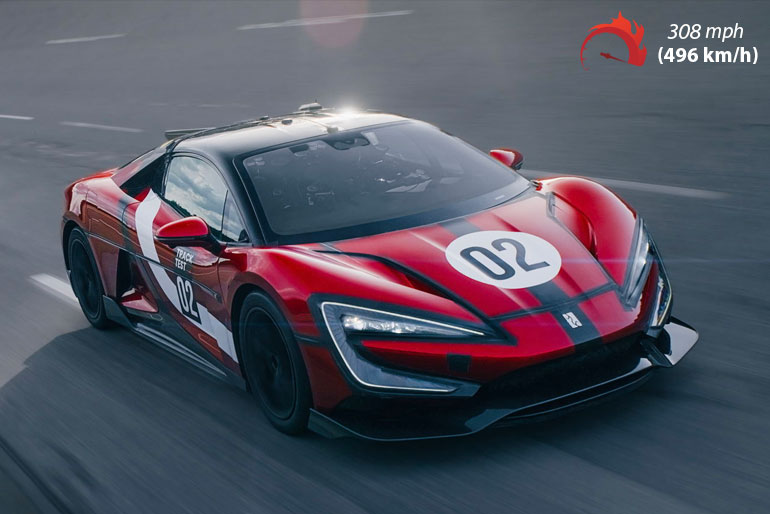
- All-Electric
- 308 Top MPH
- 1,287 Horsepower
- 2.36s 0–62 MPH
- 4× EV – Quad Motor
Nobody outside China saw this coming, and that’s kind of the point. BYD’s luxury sub-brand Yangwang dropped the U9 Xtreme and made a huge portion of the EV performance conversation look very conservative very quickly.
Here’s what got me: 257 mph from an electric car with no ICE assist. Four motors, one per wheel, with torque vectoring that is genuinely alien in its precision. I’ve read test reports where journalists describe the handling as feeling “pre-emptive” — like the car moves before you fully commit to the steering input. That sounds like marketing speak until you realize the processing speed of the torque vectoring system actually outpaces human reaction time.
The U9 Xtreme also features an active suspension system that can raise one corner of the car independently — a “dance mode” went viral online, and while that’s a party trick, the underlying tech is dead serious for high-speed stability. This car represents a genuine shift in where performance engineering is happening.
3. SSC Tuatara – 295 mph (475 km/h)
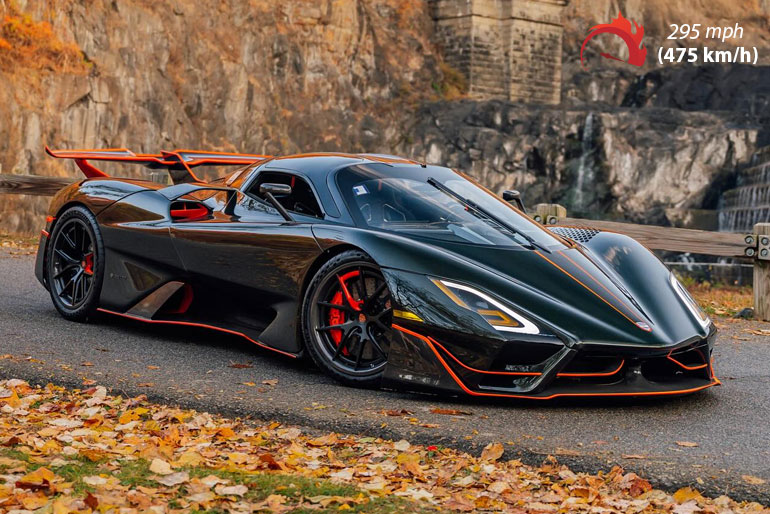
- ICE Hypercar
- Record Contender
- 295 Claimed Top MPH
- 1,750 Horsepower (E85)
- 2.5s 0–62 MPH
- 5.9L V8 Twin-Turbo
The Tuatara has had a messy public history, and I won’t pretend otherwise. A 2020 speed run on a Nevada highway produced footage that sparked serious controversy, with critics using video analysis to suggest the claimed 331 mph was far off. SSC ran it again under more controlled conditions and hit 282.9 mph averaged over two runs — still a world production car record at the time.
The drama actually makes this car more interesting to follow. SSC is a small American operation competing directly with companies like Koenigsegg and Bugatti that have decades more resources. The Tuatara’s 5.9L V8 is built in-house and produces 1,350hp on 91-octane pump gas — or 1,750hp when you feed it E85 ethanol fuel. That fuel-switchability alone is a practical engineering achievement worth noting.
On E85, the Tuatara becomes one of the highest-horsepower production cars ever made. Running it on pump gas still gets you 1,350hp — which is more than enough to ruin most other cars’ day.
4. Bugatti Tourbillon – 277 mph (446 km/h)
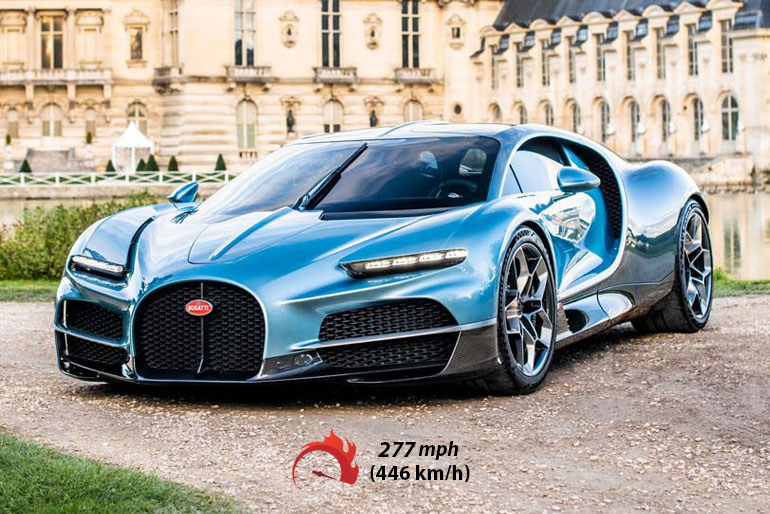
- Hybrid
- French Luxury
- 277 Top MPH
- 1,800 Horsepower
- 2.0s 0–62 MPH
- 8.3L NA V16 + 3 Motors
The Chiron was Bugatti’s last major chapter. The Tourbillon is the next one — and it’s genuinely different. Most hybrid hypercars use a smaller combustion engine and lean on electric power to bridge the gap. Bugatti went the other direction: they built a naturally aspirated 8.3-litre V16 engine, the largest naturally aspirated engine in a production car since the early 2000s, and added three electric motors on top.
No turbos. No superchargers. Just sixteen cylinders breathing freely, revving to 9,000 rpm, producing 1,000hp by itself — and then the electric motors show up with another 800hp. The sound is reportedly unlike any modern car. One journalist described it as “what Ferrari would sound like if Ferrari had no budget constraints.”
The interior features an analogue instrument cluster with no screens — mechanical gauges inspired by fine watchmaking (hence the “Tourbillon” name, a term from horology). In a world where every dashboard is a touchscreen, this feels deliberately, beautifully contrarian.
5. Hennessey Venom F5 – 272 mph (438 km/h)
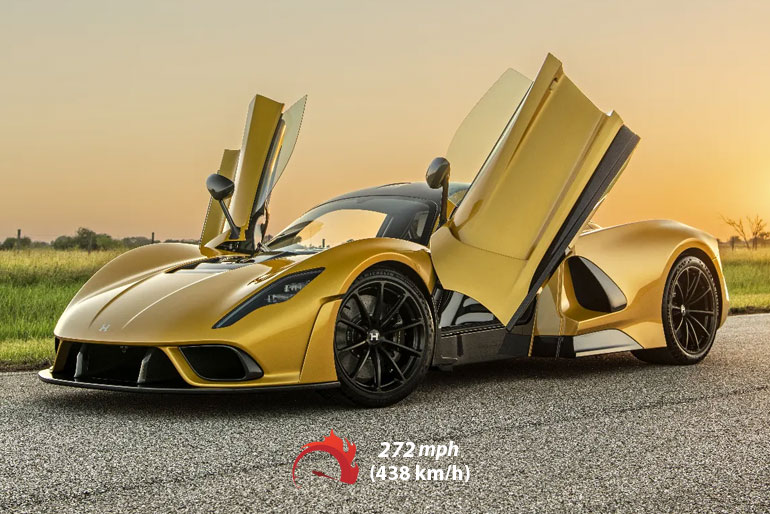
- ICE Hypercar
- Texas Built
- 272 Top MPH
- 1,817 Horsepower
- 2.6s 0–62 MPH
- 6.6L V8 Twin-Turbo
John Hennessey named this car after the F5 tornado — the most violent classification on the Fujita scale — and the performance numbers suggest he wasn’t being modest. The “Fury” V8 engine displaces 6.6 litres and produces 1,817 horsepower, which is simply one of the highest outputs in any road-legal car on Earth.
The Venom F5 has hit confirmed speeds over 270 mph during testing. The 311 mph target is still the goal, and Hennessey has been methodically closing in on it. One thing I respect about this project: they’ve been transparent about testing milestones rather than just throwing out a theoretical number and calling it done.
The chassis is mostly carbon fibre, the body is designed with a drag coefficient of just 0.33 Cd, and the car weighs about 1,360 kg despite all that power under the hood. For an American operation, the level of aerodynamic engineering here is serious.
6. Rimac Nevera R – 267 mph (430 km/h)
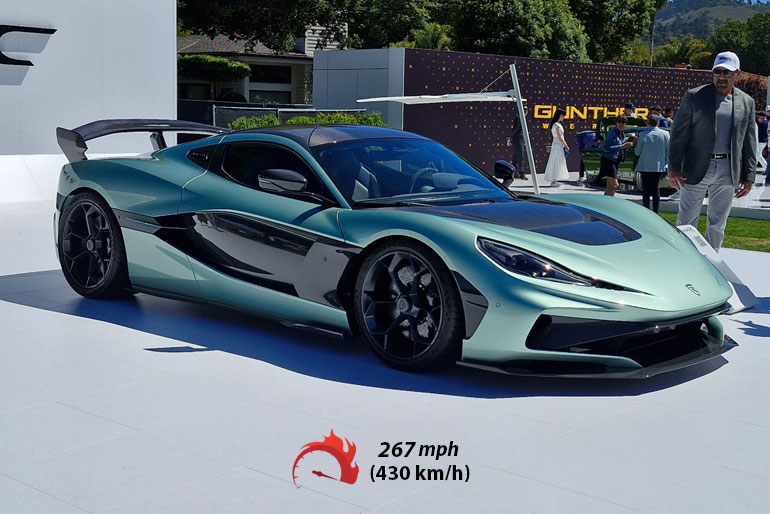
- All-Electric
- Record Holder
- 267 Top MPH
- 2,107 Horsepower
- 1.74s 0–60 MPH
- 4× EV Quad Motor
The original Nevera was already the world’s fastest accelerating production car. The Nevera R took that platform and squeezed out another 100+ horsepower, taking the total to a figure that makes most people do a double-take: 2,107 horsepower. From a four-door electric car with a full interior.
That 1.74-second 0–60 time is still the production car acceleration record. The Nevera R has held 23 performance world records simultaneously at one point. Mate Rimac built this company from a converted BMW in a Zagreb garage — that origin story alone deserves its own documentary, and there actually is one now.
What makes the Nevera R technically fascinating is the torque vectoring algorithm. Each motor can independently apply or recover energy, and the system adjusts faster than any human could. In wet conditions, the car has been described as “more planted than most sports cars are in the dry.” The engineering margin of safety here is extraordinary.
7. Aspark Owl – 256 mph (413 km/h)
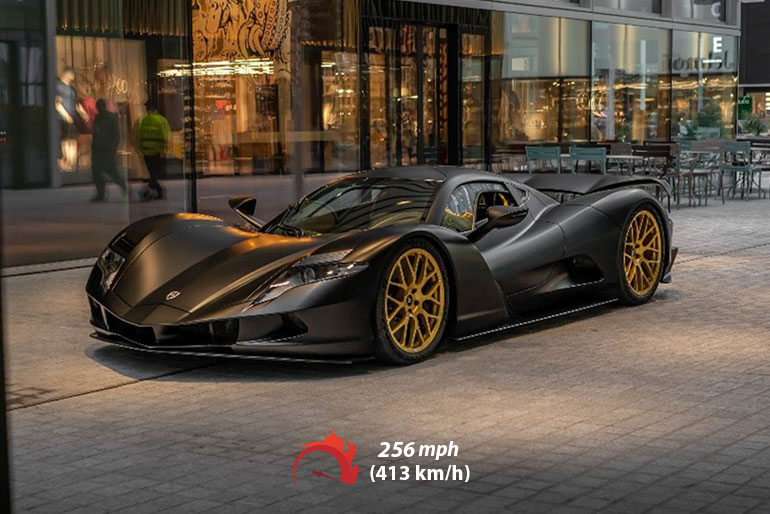
- All-Electric
- Japan’s Fastest
- 256 Top MPH
- 1,985 Horsepower
- 1.69s 0–60 MPH
- 4× EV Quad Motor
Almost nobody outside of the hardcore enthusiast world has heard of Aspark, and that’s a bit of an injustice. This Osaka-based engineering firm built an electric hypercar that held the world acceleration record before the Rimac Nevera came along — and it held it by a margin that stunned everyone who saw the data.
The Owl achieves that 1.69-second 0–60 time by, among other things, sitting just 99cm tall. Lower centre of gravity than a Lamborghini Huracán. The car is only built in extremely limited numbers — fewer than 50 globally — which is partly why it flies under the radar.
Top speed is 249 mph, which sounds modest only in this specific context. The real party piece is the launch. I’ve watched video of this car accelerating, and my brain genuinely struggles to track it. It’s the kind of performance that makes you rethink what a vehicle should even be allowed to do.
8. McLaren Speedtail – 250 mph (402 km/h)
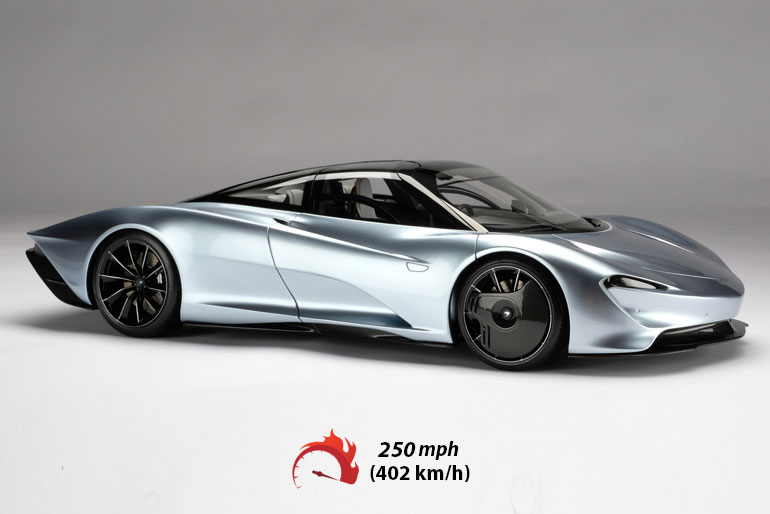
- Hybrid
- Grand Tourer
- 250 Top MPH
- 1,035 Horsepower
- 2.5s 0–186 MPH
- 4.0L V8 Hybrid
The Speedtail is an outlier on this list in the best possible way. While every other car here is built purely for speed metrics, the Speedtail is a three-seat grand tourer — a car designed to cross continents at insane speeds in complete comfort. The centre driving position is borrowed from the legendary McLaren F1.
It was tested at Kennedy Space Center’s vehicle assembly facility and recorded 250 mph in that run. The aerodynamic shape is a study in passive airflow management — no active spoilers, no movable wings. Instead, the entire rear of the car elongates like a teardrop, reducing drag at high speeds through pure geometry.
I’ll admit something: if I was given a choice between any car on this list for a long drive across Europe, I’d pick the Speedtail. The idea of cruising through motorways at technically illegal but physically manageable speeds in a car that looks like it came from 40 years in the future — with two passengers sitting slightly behind you — is quietly one of the coolest automotive propositions of the decade.
9. Koenigsegg Regera – 250 mph (402 km/h)
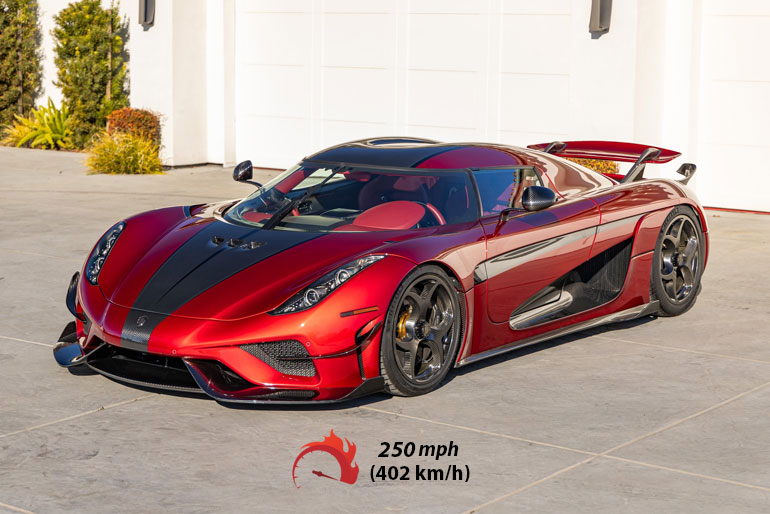
- Hybrid
- No Gearbox
- 250 Top MPH
- 1,500 Horsepower
- 2.8s 0–249 MPH
- 5.0L V8 + 3 Motors
The Regera doesn’t have a traditional gearbox. At all. Instead, Koenigsegg invented something they call the Koenigsegg Direct Drive (KDD) system — the combustion engine connects directly to the rear wheels through a hydraulic coupling, while three electric motors fill in the torque gaps across the entire rev range. The result is a car with no shift points, no torque interruption, just a constant surge of power from 0 to 249 mph.
That 0–249 mph time of 31.49 seconds was a world record when it was set, and it still stands as one of the most absurd acceleration benchmarks in automotive history. Think about that number for a second. Zero to 249 miles per hour in just over half a minute.
Only 80 were ever made, all are sold, and second-hand examples regularly trade at significant premiums. Christian von Koenigsegg has called this his most technically ambitious road car — which, given his body of work, is saying quite a lot.
10. Aston Martin Valkyrie – 250 mph (402 km/h)
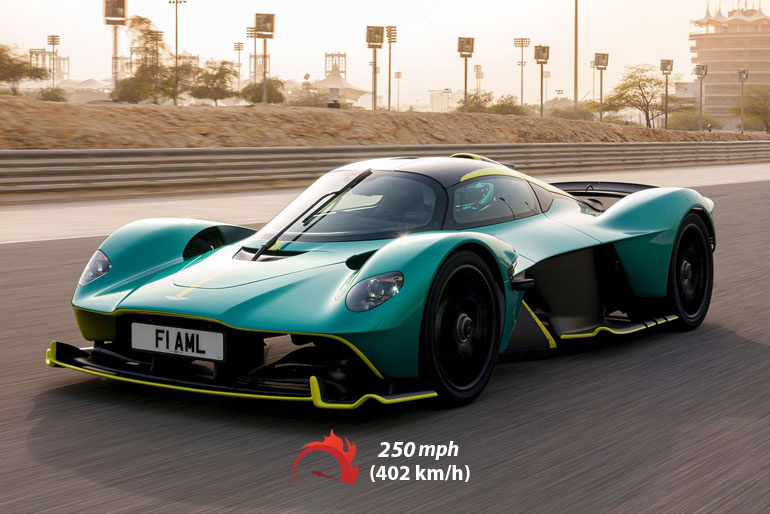
- Hybrid
- F1-Derived
- 250 Top MPH
- 1,160 Horsepower
- 2.5s 0–62 MPH
- 6.5L NA V12 + EV
The Valkyrie is what happens when Adrian Newey — the Formula 1 designer responsible for some of the most successful racing cars in history — is given a brief to make a road car with “as much downforce as possible while remaining street legal.” The result looks alien and is technically almost entirely derived from F1 engineering philosophies.
The naturally aspirated 6.5L V12 redlines at 11,100 rpm. On a road car. The exhaust note has been described by multiple journalists as the most visceral sound they’ve ever heard from a car — and those are people who routinely attend motorsport events. I believe them.
The Valkyrie generates enough downforce to theoretically drive upside down at sufficient speed. For road use, this means cornering forces that are closer to a race car than anything else in this list. Top speed is 250 mph, but the more relevant number might be its lateral G-force capability, which exceeds 3G in cornering. That’s roughly the same as an F1 car.
The Valkyrie AMR Pro version — the full track variant — produces more downforce than the car weighs at speed. That’s not a typo. It genuinely pushes itself into the ground with more force than gravity alone provides.