

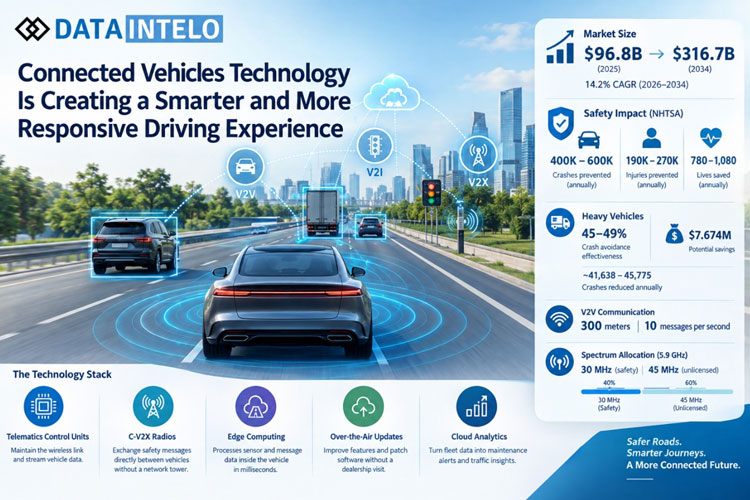
For a century, vehicles have only responded to their operators. These vehicles were employing braking systems when the operator pressed the brake pedal, steering when the driver turned the steering wheel, and in general were unable to assess the danger of the environment unless provided by either the onboard camera, radar, or by using the driver’s eyes. Thanks to connected vehicle technologies, vehicles today can respond not just to the road or the driver’s actions, but also to the surrounding traffic and other vehicles. The National Highway Traffic Safety Administration of United States of America indicates that V2V communication technology has an ability to transmit the information over a distance of 300 meters with speed of 10 messages per second.
The estimates of the market size of the connected cars technology were at the stage of being $96.8 billion in 2025 with a projection that the figure can reach $316.7 billion in 2034, which reflects an annual growth rate of 14.2% from 2026 to 2034. According to the report of Dataintelo, the market is expected to grow significantly over the next 9 years by more than tripling and resulting in valuation of its added value of approximately $219.9 billion. The market demonstrates how quickly auto manufacturers, fleet operators, and governmental institutions get connected cars as one of the key elements of vehicle performance instead of treating it as an accessory. The given data also explains the fact that safety issues, spectrum policy, and software are quoted together and connected vehicles create smarter driving experience due to the work of the three.
How Connected Vehicles Actually Work
Connected vehicles are those which consist of an onboard communication device, accurate position-finding, and software which transforms information coming in into signals. By its communications, the vehicle transmits basic information about safety like speed, direction, braking, and location. At the same time, roadside devices transit the information about traffic lights and dangers. All these modes of communications can be classified as V2V, V2I, and V2X communications. In V2V systems, for example, the driver can get information about hard braking from the vehicle several cars ahead of him long before the driver can see brake lights flashing. That is, it means that the driver keeps control all the time, receiving only alerts from the system.
The Safety Case, Backed by Federal Numbers
The strongest proof of connectedness is presented by the studies conducted by the U.S. National Highway Traffic Safety Administration (NHTSA). They show that connected vehicles can help to avoid about 80 percent of accident situations in which the driver is not distracted by anything. These are situations, like intersections or lane changes, where the driver cannot perceive the risk of a certain danger.
NHTSA also investigated two applications in detail: Intersection Movement Assist and Left Turn Assist. In combination, they may reduce collisions by 50 percent for these types of crashes. Applied to the full national fleet, the agency estimates the following annual benefits:
| Annual benefit (NHTSA estimate) | Range |
| Crashes prevented | 400,000 to 600,000 |
| Injuries prevented | 190,000 to 270,000 |
| Lives saved | 780 to 1,080 |
Those numbers describe only two applications. As indicated by the NHTSA, the application of additional vehicle-to-vehicle (V2P) and vehicle-to-infrastructure (V2I) technology will bring down fatalities. It is due to the importance of technology that the agency puts so much value on it. Even the numbers in the lower range are impressive. The implementation of the changes would allow the reduction of 400,000 accidents and 190,000 injuries.
Heavy Vehicles Show Even Stronger Returns
Trucks and buses matter because their crashes are severe and costly. A separate NHTSA study on heavy-vehicle crash warning applications built on V2V communication found an estimated crash avoidance effectiveness of 45 to 49 percent. That translates into a reduction of between 41,638 and 45,775 police-reported crashes every year.
The financial side is just as clear. The study mentions the potential savings of $7.674 million as well as the estimated save of 838 lives in post-crash comprehensive costs. This data indicates that connectivity provides benefits not only through safety improvements but also through overall cost reduction all the way through the entire logistics operation.
Testing Proved the Concept on Real Roads
In 2012, the Department of Transport organized the Safety Pilot Model Deployment, which tested almost 2800 different cars with the help of V2V and V2I technologies. The study analyzed real-life driving of 147 drivers who experienced driving of passenger cars with V2V about six months.
The importance of this was that it measured driver acceptance instead of just hardware capability. Warnings that are not complied with are of no use; therefore, people want to see if alerts come quickly enough and peak appropriately according to human factors studies. Testing for six months was important in understanding how the driver adapted to the novelty. The exposure of 127 participants for six months each give 762 month-participants of driving experience for the study which is enough for understanding the effectiveness of alerts during drives.
Spectrum: The Invisible Infrastructure
Connected vehicles rely on the radio spectrum, and U.S. policy has changed greatly. Since 1999, the use of the 5.9-GHz band has been assigned to intelligent transportation systems by the FCC. The assignment was changed after the FCC allocated 45 MHz of the total frequency (5.850-5.895 GHz) to unregulated devices and 30 MHz (5.895-5.925 GHz) to safety purposes.
The FCC also required that in the case of the use of the above 30 MHz, the industry would stop using the DSRC technology and move to the use of Cellular Vehicle-to-Everything (C-V2X). The industry now needs to operate using the narrower channel and cellular standard instead of using the entire 75 MHz formerly allocated to the vehicles. And this means that a total of 45 MHz is associated with the devices that can work for free (unlicensed devices), which constitutes 60 percent of the number of the MHz allocated for the vehicles (75 MHz), while the safety application gets 30 MHz, which is 40 percent of the total number of MHz previously allocated. This transformation has an impact on the manufacturers in terms of hardware development and software updates as well as the communication technologies on the vehicle.
The Technology Stack Behind a Responsive Drive
Several layers work together to make a car feel more responsive:
- Telematics control units that maintain the wireless link and stream vehicle data.
- C-V2X radios that exchange safety messages directly between vehicles without relying on a network tower.
- Edge computing that processes sensor and message data inside the vehicle in milliseconds.
- Over-the-air updates that improve features and patch software without a dealership visit.
- Cloud analytics that turn fleet data into maintenance alerts and traffic insights.
None of these layers works alone. The value appears when they combine, so that a vehicle can receive a hazard warning, confirm it against onboard sensors, and alert the driver in time to act.
Challenges That Still Need Solving
Connectivity also brings risks. According to NHTSA studies, V2V functions increase the potential opportunities for cyber threats and require a secure process and messaging system. Another challenge is interoperability: for a safety message to serve a purpose, any receiving vehicle must receive the same version of the message. Lastly, the required scale of implementation must be taken into consideration. According to the NHTSA, 400,000 to 600,000 accidents can be prevented if communication technologies are adopted by all drivers, but this can be a lengthy process due to the slow process of vehicle replacement. The figures for commercial fleets present a similar pattern; about 41,000 to 45,000 heavy-vehicle accidents can be prevented every year if a secure solution is implemented.
Privacy implications, expenses, and rural coverage issues complicate the situation. It is necessary to coordinate regulators, producers, and road owners in order to ensure that all people can benefit from this technology instead of limiting the technology to premium vehicles.
What It Means for Drivers and Enthusiasts
For people who care about driving, connected technology offers something different from raw power: awareness. A vehicle that knows about a stalled car around a blind corner, or a signal about to change, gives its driver extra seconds of decision time. With the market projected to climb from $96.8 billion in 2025 to $316.7 billion by 2034, more of that awareness will arrive as standard equipment across every price segment.
The federal numbers also give the industry a clear scorecard. Potential coverage of approximately 80 percent of non-impaired crash scenarios, up to 1,080 lives saved annually from just two applications, and a 45 to 49 percent effectiveness rate for heavy vehicles are benchmarks that justify continued investment.
Connected Vehicles Technology and Safer Roads
By and large, the vehicle-connected technologies allow automobiles to become more efficient, effective means of transportation. This trend seems to destroy long-established notions. According to the National Highway Traffic Safety Administration, just two technologies -the Intersection Movement Assist and the Left Turn Assistance -may prevent 50 percent of automobilism accidents, which would mean as much as 400,000 to 600,000 accidents, as many as 190,000 to 270,000 injuries, and 780 to 1,080 deaths a year. If connected vehicles offer more devices of the vehicle-connected technology, we may eventually be able to eliminate non-drunk driving devices by 80 percent. Messages that travel approximately 300 meters and update up to 10 times per second let connected vehicles detect threats well before a camera or radar unit would.
The FCC has allocated 30 megahertz of the 5.9 GHz band for intelligent transportation systems and opened a further 45 megahertz to usage without a license, and the NHTSA’s estimate of the cost of a vehicle to be between $341 and $350 in 2020 has reduced to only about $209-235 because as production experience increases, the cost will fall. With an expected growth rate of 14.2%, from $96.8 billion in 2025 to $316.7 billion in 2034, the market provides automakers, vendors, and fleet companies with the means and motivation to keep innovating. As a result, the driving process becomes not just intelligent but safer, and each kilometer is taken with an earlier warning, better information, and sufficient time for a proper response.
Reference: https://dataintelo.com/report/global-connected-vehicles-technology-market